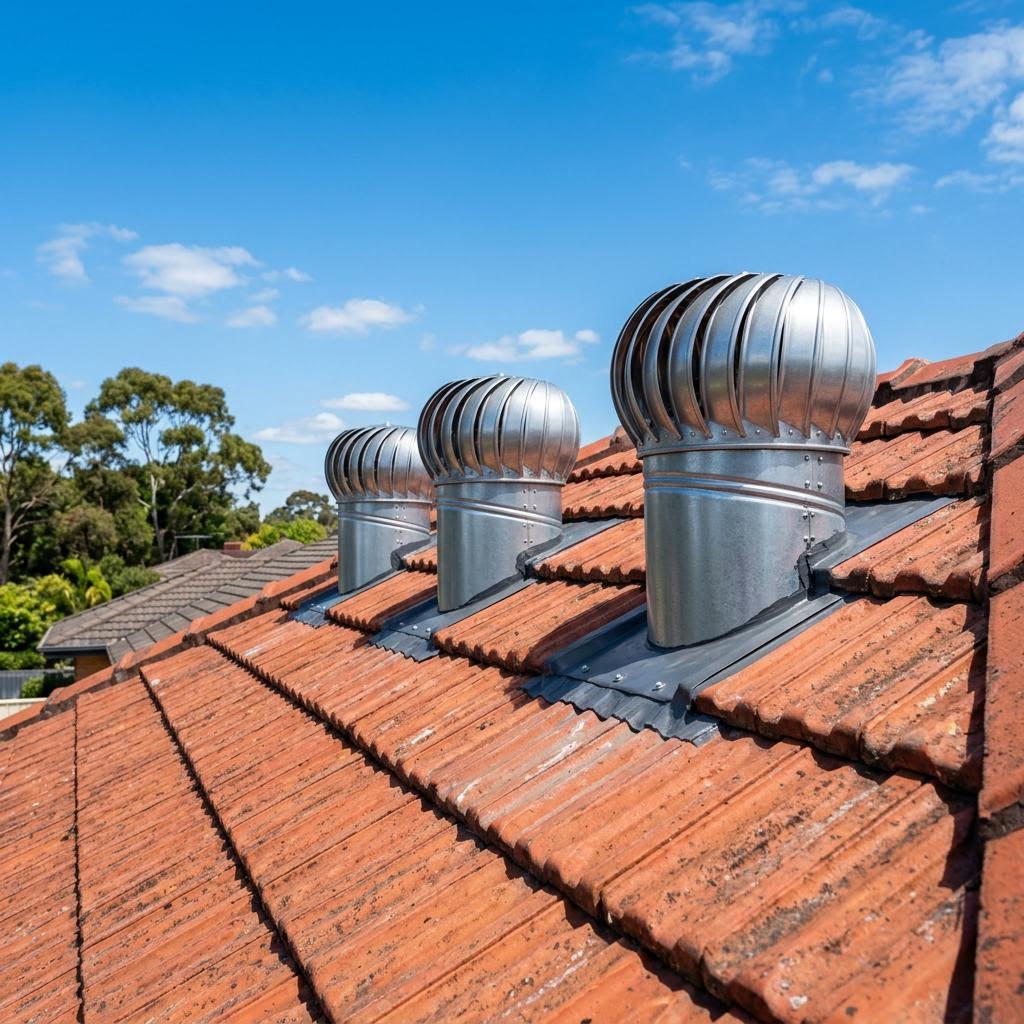
Stick your head up into the roof cavity on a hot summer afternoon and you'll understand this article in about three seconds. The air up there can be brutally hotter than outside, thick and still, with heat radiating off the underside of the tiles or sheeting. That trapped air isn't just uncomfortable — it's quietly working against your house all year round. Roof ventilation is the simple, often-overlooked answer, and in the Australian climate it earns its place.
Most homes are built to keep weather out, and rightly so. But a sealed-up roof cavity with nowhere for hot or moist air to escape creates its own set of problems. This guide explains what roof ventilation does, why both heat and moisture matter, the main types available, and how to tell whether your roof is struggling to breathe.
What Roof Ventilation Does
Roof ventilation is about airflow — letting hot, stale, moist air out of the roof cavity and drawing cooler, fresher air in to replace it. The most effective setups work on a simple principle: air enters low, usually at the eaves, and exits high, near the ridge. As the hot air rises and escapes, it pulls cooler air in behind it, creating a gentle, continuous flow. No moving parts required for the passive types — just physics doing the work.
The goal isn't to turn your roof into a wind tunnel. It's to stop the cavity becoming a sealed oven in summer and a damp box in the cooler months. A cavity that can breathe stays closer to the outside temperature and dries out far more readily.
The Heat Problem
In an Australian summer, an unventilated roof cavity soaks up an enormous amount of heat during the day and holds onto it well into the evening. That heat radiates down through the ceiling into your living spaces, which makes the rooms below harder and more expensive to cool. Your air conditioner ends up fighting a hot ceiling long after the sun has gone down.
Insulation helps slow that heat transfer, but insulation and ventilation do different jobs — they work best together. Insulation resists heat moving through it; ventilation removes the built-up heat from the cavity in the first place. Relying on insulation alone in a stifling, unventilated roof is asking it to do more than it's designed for.
The Moisture Problem
Heat gets all the attention, but moisture is arguably the bigger long-term threat, and it's a year-round issue. Everyday living pushes a surprising amount of water vapour up into the roof — cooking, showers, drying clothes indoors, even breathing. In cooler weather, when that warm, moist air hits the cold underside of the roof, it condenses into water droplets. If there's nowhere for that damp air to escape, the moisture lingers.
Over time, trapped moisture leads to mould growth on timber and the underside of the roof, rot in battens and framing, rusting of metal fixings, and insulation that gets damp and stops working properly. None of this is dramatic on any given day, which is exactly why it goes unnoticed — until you find blackened timber or musty insulation years down the track. Good ventilation lets that moist air out before it can settle and do damage.
The Main Types of Roof Ventilation
There's no single right answer — the best option depends on your roof type, its pitch, its size and your budget. Here are the common approaches you'll come across.
- Whirlybirds (turbine vents) — the spinning domes on the roof. Wind turns the turbine, drawing warm air out of the cavity. Simple, no power needed, and a common choice.
- Ridge vents — run along the peak of the roof to let hot air escape continuously across the whole ridge line rather than at single points.
- Eave and soffit vents — inlets down low that let cool air enter. These are what make the high-level exhaust vents work properly; without inlets, the outlets have little to draw on.
- Powered vents — electric or solar-powered fans that actively pull air out of the cavity, useful for larger or particularly hot roof spaces.
- Gable vents — openings in the end walls of the roof space that allow cross-flow ventilation.
The key thing that ties all of these together is balance. Exhaust vents up high only work if there's somewhere for fresh air to come in down low. A roof with three whirlybirds and no eave intake won't perform anywhere near as well as a properly balanced system with both inlets and outlets.
Signs Your Roof Isn't Breathing
You don't need special equipment to pick up the clues that a roof cavity is struggling.
- Upstairs or top-floor rooms that stay uncomfortably hot into the evening even with cooling running.
- A roof cavity that feels intensely hot and stuffy when you put your head up there.
- A musty or damp smell coming from the ceiling space.
- Visible mould or dark staining on the underside of the roof or on timber battens.
- Damp, compressed or discoloured insulation.
- Condensation droplets on the underside of metal roofing in cooler weather.
Getting the Balance Right
Ventilation is one of those upgrades that's cheap and disruptive-free compared to the damage it prevents. But it's worth getting right rather than just bolting on a whirlybird and hoping. The number and type of vents, and crucially the balance between intake and exhaust, all matter for a system that actually moves air. Adding outlets without inlets, or piling on too many vents in the wrong spots, wastes money and can even work against you.
If your top-floor rooms are baking, your roof cavity smells damp, or you've spotted mould on the timbers, it's worth having someone take a proper look at how your roof is currently ventilated. We offer a free, no-obligation inspection and can talk you through what would suit your specific roof — no upselling, just what makes sense. Give us a call on 0416 689 689.