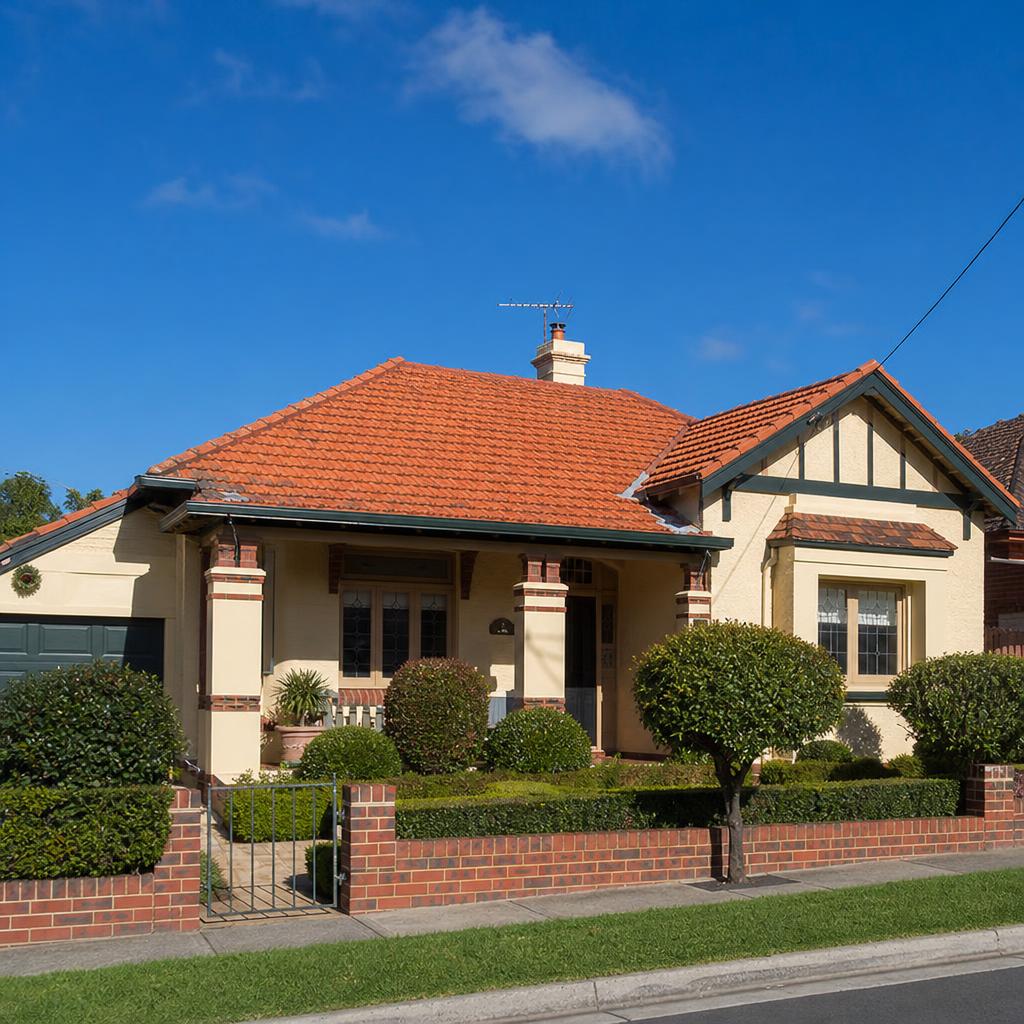
Not every roof is a steep triangle of tiles. Rear extensions, first-floor additions, garages, alfresco areas, balconies over living space and commercial buildings all tend to have flat or low-pitch sections. And these roofs play by a completely different set of rules. On a steep tiled roof, gravity does most of the waterproofing work — water simply runs off before it can get in. On a flat or low-pitch roof, water hangs around, so the surface itself has to be genuinely waterproof, not just water-shedding.
That's why you can't just carry tiles or standard sheeting across a near-flat section and hope for the best. This guide runs through the low-pitch and membrane options we come across on Sydney homes and buildings, and where each one actually makes sense.
First, What Counts as 'Low-Pitch'?
Roof pitch is just the slope, usually expressed in degrees. Tiles generally need a decent slope to work, because they overlap rather than seal. Once you drop below the minimum pitch a tile is rated for, water can creep back up under the laps in heavy rain. Metal sheeting can go much lower, and some profiles are designed specifically for low-pitch runs. Below the point where sheeting works reliably, you're into genuinely flat territory — and that's where waterproof membranes take over.
Metal Sheeting for Low-Pitch Runs
For a gently sloping extension roof, long-run metal sheeting is often the simplest answer. A single continuous sheet running from ridge to gutter with no horizontal joins means there's nowhere for water to sneak back in. Low-pitch profiles have taller ribs and are laid with the right laps and sealing to cope with slower-draining water. It's a proven, cost-sensible choice for a lot of rear additions, and it ties in neatly if the rest of the house is already metal.
Waterproof Membranes for Flat Sections
When a section is genuinely flat — a balcony over a room, a concrete slab roof, a box gutter, or a flat commercial roof — you need a continuous waterproof membrane. Common membrane types include:
- Liquid-applied membranes, which are painted or rolled on and cure into a seamless waterproof skin — good for detailed areas with lots of penetrations.
- Sheet membranes, which are rolled out and heat-welded or bonded at the joins to form a continuous surface.
- Torch-on membranes, a bitumen-based sheet system melted down onto the substrate, long used on flat commercial and residential roofs.
The right choice depends on what's underneath, how much foot traffic the surface gets, how many pipes and outlets penetrate it, and whether it's exposed to full sun. There's no single 'best' membrane — there's the one that suits your particular flat section.
Trafficable vs Non-Trafficable Surfaces
One thing that trips people up is whether the flat surface is meant to be walked on. A membrane over a balcony or a rooftop terrace has to be trafficable — tough enough to take foot traffic, furniture and the odd dropped pot plant without splitting. A membrane on a roof nobody stands on can be lighter-duty. Getting this wrong is a common cause of failure: a membrane spec'd for a roof that's never walked on gets used on a balcony, and it wears through where people step. If your flat section doubles as an outdoor living space, that has to be part of the conversation from the start.
Why Falls and Drainage Matter So Much
The word 'flat' is misleading. A well-built flat roof isn't dead level — it's given a slight fall towards its outlets so water actually drains away instead of ponding. Ponding water is the enemy of a flat roof: it sits over any weak point in the membrane, works into the smallest pinhole, and finds the ceiling below. If we're assessing a leaking flat section, one of the first things we look at is whether it drains properly or whether water is pooling and going nowhere.
Common Failure Points on Flat and Low-Pitch Roofs
Flat roofs rarely fail across the open field of the membrane. They fail at the edges and details — where the membrane turns up a wall, around a drain outlet, at the join to the pitched roof above, or where an old membrane has simply reached the end of its life and gone brittle. Box gutters are another classic trouble spot: they carry a lot of water in a confined space, and if they block or the falls are wrong, water backs up over the edge and into the building.
Getting the Junction Right
Most low-pitch roofs meet a pitched roof somewhere — the extension tucks under the eaves of the original house. That junction is critical. It needs proper flashing and the membrane or sheeting carried up high enough that driving rain can't get behind it. A lot of the flat-roof leaks we chase aren't in the flat roof at all — they're at this transition, where two different systems have to be married together properly.
Repair or Replace a Failing Flat Roof?
When an older membrane starts leaking, the honest question is whether it's worth patching or whether the whole surface has reached the end of its life. A single failed detail — a lifted edge, a cracked upstand, a blocked outlet — can often be repaired well. But once a membrane has gone brittle and is cracking across the field, patching one spot just moves the leak somewhere else. We'd rather tell you a tired membrane needs replacing than keep charging for patches that won't hold. On commercial buildings especially, a planned re-membrane is usually cheaper in the long run than a string of emergency call-outs.
If you've got an extension, a flat garage roof, a leaking balcony or a commercial building with a low-pitch or membrane roof, we're happy to take a look. Call 0416 689 689 for a free, no-obligation inspection and an honest read on what your flat section needs.